Dodecad
Definition
The dodecad is the twelve-term system, whose attribute is perfection. It carries integration beyond the ennead and octad: where the ennead shows how nature's hazards can be overcome dynamically, the dodecad describes a structure complete enough to combine dynamism with diversity — relativity and relatedness together — and so counts, for Bennett, as "the culmination of the transformations whereby the structure of existence is first disordered, then corrected, then redeemed and, finally, perfected."
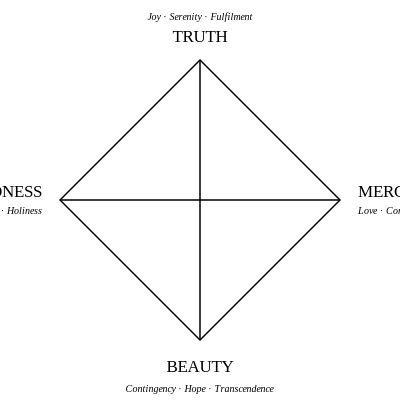
The Points of the Diagram
Bennett is candid that the dodecad, like the heptad, resists a single settled figure at the point he introduces it: "we shall find, in the next chapter, a twelve-term structure of Value with various subsidiary structured features. We can, therefore, dispense with an attempt to illustrate at this stage the practical use of the dodecad." What he offers instead, in Chapter 37, is the kind of term-character the dodecad's points will have — not one uniform character, as in simpler systems, but three distinct types layered together: "1. Upper and Lower: in hexads. 2. Dynamic: in triads. 3. Cooperative: in tetrads." The dodecad's structure is thus explicitly a combination of systems: twelve points that behave, in different groupings, like hexads, triads and tetrads all at once.
The following chapter makes this concrete, and gives the diagram above. Bennett takes the twelve base values already established (Contingency, Hope, Transcendence; Conflict, Need, Holiness; Love, Concern, Discrimination; Joy, Serenity, Fulfilment) and shows that "each value in the progression is connected with one of the first four systems… When these are grouped into four triads we obtain" four Coalesced Values — themselves the four points of an overarching tetrad:
- Beauty (the ground, bottom) — the coalescence of Contingency, Hope and Transcendence: "beauty requires spontaneity" (Contingency as the receptive term), draws the self onward through longing (Hope as the reconciling term), and "has a transcendent quality that gives to Nature more than Nature has" (Transcendence as the affirming term). "It is a triad of monads. By its triadic constitution, it is complete. By its monadic character it is universal."
- Goodness (the feminine, instrumental term, left) — the coalescence of Conflict, Need and Holiness: goodness "arises out of conflict," is driven by Need, and is done "for the sake of the Holy." Goodness occupies "the place of the feminine instrumental value" in the tetrad, but by itself "lacks dynamism" — it cannot yet reach out to others.
- Mercy (the counterpart of Goodness, right) — the coalescence of Love, Concern and Discrimination: "the affirmation of Love transforming Concern into action through Discrimination." Mercy and Goodness "together are the instruments for the Realization of Value," the tetrad's operational pair — "I will have Mercy and not sacrifice."
- Truth (the goal, top) — the coalescence of Joy, Serenity and Fulfilment: the triple fulfilment sought "in the natural order as bliss, in the order of self-hood as the union with Individuality, and in the universal order as the Beatific Vision." As "the highest member of a tetrad," Truth is not a static endpoint but, in Aquinas's phrase Bennett borrows, "the supreme act by which potential becomes real" — "a perpetual creation" that "never ends and yet is always complete."
Three base values, four coalesced values, twelve terms in all: the dodecad realized concretely as the multiplicative combination Bennett names back in the heptad chapter — 3 × 4 = 12 — as against the heptad's own additive 3 + 4 = 7.
Key Points
- Bennett treats the ten-term (decad) and eleven-term (undecad) systems only in passing, naming their probable attributes — integrative complementarity for the decad, and synergism (man's cooperation with the Divine Will) for the undecad — but sets their full systematics aside: "this is not to say that the pure Systematics of the decad and undecad are beyond investigation; but that they are too complex to be pursued further here." He treats both as characterizing whole societies or communities "in a state of dynamic harmony" rather than single, well-bounded structures.
- Twelve recurs everywhere in The Dramatic Universe as the mark of a completed classification, not by mere convention but, Bennett insists, because the dodecad is "the first system in which the main elements of our experience can all be represented": twelve categories of Fact, twelve levels of Potency, twelve levels of Existence, twelve gradations of Energy, twelve Substances, twelve stages of Creation and the twelve Essence Classes.
- The traditional association of twelve with perfected structures is not, for Bennett, mere numerology: "we shall see, in a later chapter, that the perfect human society should be composed of twelve groups" — a claim developed later in the work's treatment of history and community.
- Perfection completes the arc begun at the ennead: the ennead shows hazard being overcome dynamically and indeterminately, and the dodecad shows the structure within which that dynamic harmony can be sustained — the last system, in Bennett's account, "of the third tetrad of systems" that runs from ennead to dodecad and is "mainly concerned with the harmony of the structures," as against the first tetrad (monad–tetrad, how structures work) and the second (pentad–octad, why they work).
In the Sources
- The Dramatic Universe III introduces it directly from the ennead: "when we go on to the dodecad, we find a type of structure of such universal and such concrete importance that it should be thoroughly investigated… the dodecad combines dynamism and diversity, or relativity and relatedness."
- It treats the decad and undecad as real but bypassed steps, giving their attributes before declining to develop them: "the ten-term system appears to have the systemic attribute of integrative complementarity… the eleven-term system goes farther and provides the conditions for mutual completion of structures of different kinds: we shall refer to synergism… their systematics are not… beyond investigation; but… too complex to be pursued further here."
- Chapter 38 makes good on the promise to illustrate the dodecad concretely: "the entire scale of values is contained in the Dodecad," worked out as four triads of value — Beauty, Goodness, Mercy and Truth — each itself "a coalescence of the natural, the personal and the universal."
- Elementary Systematics preserves Bennett's own grouping of all twelve systems in three tetrads, confirming the dodecad's place as the culmination of the third: "The third group from the ennead to the dodecad is mainly concerned with the harmony of the structures."
Related
In the Books
Where “Dodecad” appears across the collected texts.
DU II — 5 sections
DU III — 9 sections
- Sub-Structures 11×
- Part Fourteen: Systems Chapter 37. the Structure of the World 3×
- The Transformation of Value Experience 3×
- The Structure of the World 2×
- Chapter 29. 2×
- Human Societies 2×
- Glossary of Terms 2×
- Order 2 Expansion 3 Identity 4 Freedom 5 Concentration 6 Interaction 1×
- The Ideal Human Society 1×