Heptad
Definition
The heptad is the seven-term system, whose attribute is transformation. Where the hexad gives the structure of a completed event, the heptad accounts for the distinct stages by which one state of being changes into another — the pattern behind Gurdjieff's law of octaves. Bennett defines transformation precisely as the kind of change in which three things happen at once: an entity realizes itself; in realizing itself it acquires properties that were not even possible for it before; and, while retaining its own identity, it becomes integrated as a part into a greater whole.
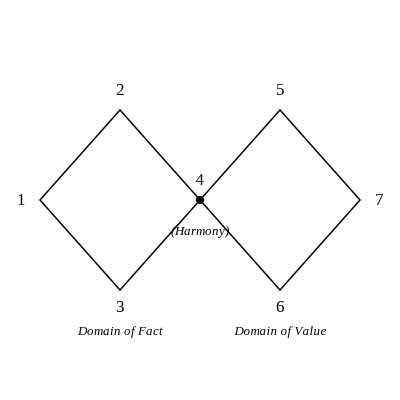
The Points of the Diagram
Bennett is unusually candid that the heptad resists a single picture: "there is no universally recognized symbol for the heptad and this is probably because it cannot be represented completely by any stationary figure. Transformation is not understood by its beginning and end, nor even by the path that joins them, but by its total action." Rather than one diagram, he offers several partial ones, each catching a different aspect:
- Two tetrads with a common point (the figure above, from A Spiritual Psychology) is the diagram he returns to most. Each square is itself a tetrad of activity — 1-2-3-4 can be read as the Domain of Fact (that which is transformed) and 4-5-6-7 as the Domain of Value (that which acquires substance through the transformation) — and the two share their fourth point, which stands for the Domain of Harmony: the transformation itself, "realized" rather than merely enacted. Bennett flags the diagram's one weakness himself: drawn this way, point 4 looks like just another point among seven, when it is actually doing triple duty — the end of the Domain of Fact, the start of the Domain of Value, and the act of transformation that joins them.
- The Greek heptachord, the seven-stringed lyre-scale running from hypate to nete through the mese (the "middle string," itself the centre of the tetrachord system), shows how two tetrachords unite to "give the complete harmony of the diapason" — Bennett's illustration, after the Pythagoreans, of transformation as neither simple addition nor simple transition: "when we unite the triad with the tetrad, we say that we make seven. This assertion, however, is not true: for monads conjoined with monads produce indeed the subject of the number seven, but nothing more" — the systemic attribute of the heptad has to be recognized as more than its arithmetic.
- The spectrum, the octave of sound, and Gurdjieff's "opium" are three further, complementary pictures Bennett takes from Beelzebub's Tales: the spectrum brings out the heptad's integrative blending of qualities, the octave of sound its combination of three independent factors, and the structure of opium its seven distinct qualities — "this complexity should not surprise us: the heptad is an advanced structure and combines integration and diversification in a very remarkable way."
- Even the arithmetic carries meaning: the heptad is the additive combination of triad and tetrad (3 + 4 = 7), as against the octad's or dodecad's multiplicative combinations (3 × 4 = 12) — "the combination of systems is not obtained by addition alone, for this cannot bring out the unique attribute of which the higher system is the bearer." Seven gives quantity; only the recognized structure of transformation gives the heptad its meaning.
Key Points
- Bennett sets down a formal terminology even without a settled symbol: "Seven-term system: HEPTAD. Systemic attribute: TRANSFORMATION. Subsidiary attributes: Structure, History. Term Designation: STATE." The seven term characters — Completion, Renunciation, Insight, Harmonization, Separation, Involvement, Initiation — are, he insists, states rather than qualities or stages, and he declines to gloss them individually: their common significance "is not expressible in any words in general use." Their first-order connectivities are called Intervals, and the second-order connectivities Harmonies — the vocabulary of music, deliberately carried over.
- The heptad distinguishes kinds of change from kinds of entity or mode of existence: simple, undirected actualization (the hexad's coalescence) is not the same thing as purposive transformation, and "action itself is totally different for different structural situations" even when the things acted upon are alike.
- Elementary Systematics gives the heptad's negative case as vividly as its positive one: an event can be real and yet fail to become history if it finds no correspondence with its environment — "the charge of the Light Brigade at Balaclava reverberates as an event, but it failed to become part of history," and with it, Bennett argues, the whole Crimean War, which left Europe back at the status quo of 1848. Structure and History are named as the heptad's own subsidiary attributes for exactly this reason.
- Bennett ties the heptad to soul-formation: body and spirit are governed by tetrads of activity, but soul "develops from the monad of simple possibility of existing to the heptad that integrates into a complete whole both itself and also body and spirit" — man's own transformation is heptadic in structure, hazardous because it must reconcile two natures that cannot be renounced.
- The heptad and hexad together are needed before systems can address hazard and incompleteness, which is the province of the octad and beyond.
In the Sources
- The Dramatic Universe III opens the section by distinguishing "radically different kinds of change" from the coalescent structures of the hexad, and introduces transformation as change in which "an entity becomes or realizes itself… acquires new properties that were not potential or even possible in its non-realized state… [and] while retaining its identity is integrated into a structure as a part into the whole."
- The same volume sets down the full terminology and warns against over-interpreting its own diagram: the double-tetrad symbol's "weakness… lies in the apparent equivalence of all the points including No. 4," and, separately, that reading the heptad's seven states as literal sequential "levels" or "stages" is a related, tempting misreading — "they are not all of equal importance, nor, in general, do they succeed one another in time."
- Elementary Systematics frames the heptad's attribute as integration — "an operation both within the system to complete its own structure and without the system, which is thus brought into harmony with its environment" — and offers the engineer's image that "a completely stable structure requires seven independent supports."
- It notes soul, unlike body and spirit, "develops from the monad of simple possibility of existing to the heptad that integrates into a complete whole."
- The Dramatic Universe III also credits Gurdjieff with resolving an apparent conflict — whether the seven terms are best understood as stages or as qualities — by combining three images at once (opium, spectrum, octave), each carrying a different one of the three.
- The Mdnel-Ins and Harnel-Aoot (talk, 31 Dec 1973). In food transformation, Harnelmiatznel carries the food as far as the liver, where "our food comes to life… the vivification of the food," and then "can no longer carry it forward… This is where we pass from the law of three-foldness to the law of seven-foldness." Help must come "from outside" at the Mdnel-In: here the air, "a process of reinforcement," for "the potential of the air for transformation is greater than it needs for its own harnel miatznel." Harnel-Aoot, "the isolating process," is at sol, "where one has lost contact with the start and hasn't yet found contact with the end… the valley of desolation, dark night of the soul… a separation between I must and I cannot." In learning a movement, "if you really sincerely are working for perfection, you're bound to come to a moment of despair… If you can once get through this… from then onwards, you're sure of getting there… the end is beginning to be a force that's working in you." Of the fifth Piandjiohary in the cerebellum: "By means of it, we are either able to go ahead and create or we're able to be satisfied. If we surrender to the impulse to be satisfied… that satisfaction puts an end to the process." Of the second, intentionally actualized Mdnel-In, on which the soul depends, "Gurdjieff would never answer questions about it"; Bennett deferred it "six or seven weeks" (machine transcript) (completion, three_foods).
- The tastes of the stopinders (8 Dec 1974). "Don't try and make cross-correspondences with what is said in the Purgatory chapter… they do not come from the same tradition." One must know by experience "the taste of the Harnel-Aoot," "the birth pang of the process… the dark night of the soul," and the Pianjoehary, where "there is always an easy way out… we can either enjoy it, or we can serve it." "This has been a mistake that has been made many times, that this is presented from the outside… the same mistake… in Ouspensky's In Search of the Miraculous… it is something which has to look out from you" (machine transcript; holy_planet_purgatory).
Related
In the Books
Where “Heptad” appears across the collected texts.