Hexad
Definition
The hexad is the six-term system, whose attribute is coalescence or structured event: the coming together of independent processes into a single, self-renewing whole. Bennett associates it with the full cycle of an event in time — its birth, unfolding and completion.
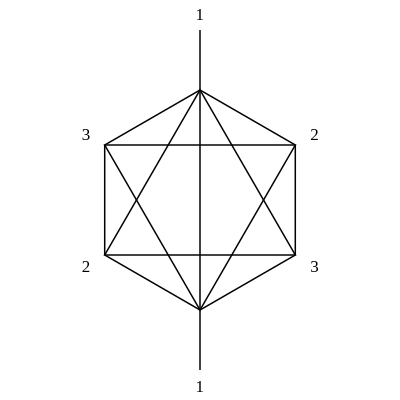
The Six Points of the Diagram
The hexad is built directly out of the triad. Bennett takes the three Cosmic Impulses — Affirmation (1), Receptivity (2), Reconciliation (3) — and arranges them as a hexagon, each impulse appearing twice: "each point characterizes a triad by indicating the central impulse. There are two triads according to which of the other two impulses initiates." Reading around the hexagon in this way yields exactly six triads, and these six — not the three impulses themselves — are the true "term characters" of the hexad. Bennett gives them their own names, the Six Fundamental Laws, and groups them by the two triangles the hexagon contains:
- Order (3-1-2) and Freedom (3-2-1) — the pair initiated by Reconciliation, together resolving Bennett's free-will/necessity dilemma: Order is the law that keeps Existence "within the bounds of possibility", while Freedom, its opposite, is the one "impossible" law by which Existence can escape the nexus of laws altogether.
- Expansion (1-2-3) and Concentration (2-1-3) — the pair initiated by Affirmation and Receptivity respectively, "the twin principles of change and conservation": Expansion is the outward transmission of potentiality into act, while Concentration moves "against the stream," from the actual back toward the potential.
- Identity (2-3-1) and Interaction (1-3-2) — the pair that share Reconciliation in the middle, giving every entity, respectively, its inner and outer significance: Identity is the "thusness" by which a thing is enabled to be what it is, while Interaction is the natura naturata, the endless flux of events by which things act upon one another.
These six laws, taken together, are the hexad's two triangles: "the triads of order, expansion and identity bring the universe into being and maintain its existence. The three triads of freedom, interaction and concentration enable Existence to escape from its own limitations and recover the Unity of Being sacrificed in the act of creation." See six_fundamental_laws for the full derivation of the six from the triad; here they reappear as the hexad's own points — no longer a property of the triad but a system in their own right, whose first-order connectivities Bennett calls steps, thirty in all, "since the direction of the step influences its character."
Key Points
- The hexad unites the six fundamental triads into one scheme; an event is complete when all six modes of action have found their place — which is why Bennett calls the hexad's term designation simply Law: "Laws govern the coalescence of Events."
- Bennett links the hexad with the symbolism of interlaced triangles and with the structure of a work or enterprise that has become capable of maintaining itself: the two triangles together show "how the universe can be both a created and also a self-creating structure."
- A separate, related Sufi symbol — akin to, but distinct from, the Rosicrucian pentacle — numbers its points by the recurring decimal 1/7 = 0.142857 and draws two broken triangles (147 and 285) rather than two whole ones, so as to combine cyclicity with irreversible progress in a single figure; Bennett develops this into the enneagram.
- Beyond the hexad, the seven-term system (heptad) governs completed processes of transformation — the octave of Gurdjieff's teaching — and the eight-term system (octad) governs fully individuated wholes.
In the Sources
- The Dramatic Universe II defines the attribute: "The six-term system, or hexad, can be seen as the minimum required for prescribing the full concreteness of an event. Events are the elements or ingredients of history, and are to be distinguished from mere happenings."
- The Dramatic Universe III sets down the full terminology: "Six-term system: HEXAD. Systemic Attribute: COALESCENCE. Subsidiary Attributes: The forms of Events, Recurrence, Progress and Self-Realization, Independence. Term Designation: LAW… Term Characters: 1 Order, 2 Expansion, 3 Identity, 4 Freedom, 5 Concentration, 6 Interaction. 1st Order Connectivities: STEPS" — thirty of them in a fully coalescent structure.
- The Dramatic Universe IV notes that "coalescence was first introduced in Vol. III as the attribute of the hexad" — the coming together of processes by which the present moment realizes its own pattern.
- Elementary Systematics connects the hexad to hyparxis: "I associated the hexad with recurrence and the sixth dimension that I called hyparxis… it allows that which already is what is to become what it is. Self-realization in this sense does not mean transformation into something different, but to become in actuality what one was only in potentiality."
- The Dramatic Universe III observes that cyclicity belongs to six-term systems, comparing two hexads of vast difference in scale — the cycle of life on earth and the cosmic cycle — that show "remarkable morphological similarities."
Related
In the Books
Where “Hexad” appears across the collected texts.
DU II — 3 sections
DU III — 12 sections
- Single Terms 9×
- Part Fourteen: Systems Chapter 37. the Structure of the World 6×
- Sub-Structures 6×
- The Structure of the World 5×
- The Higher and Lower Natures 5×
- Order 2 Expansion 3 Identity 4 Freedom 5 Concentration 6 Interaction 4×
- Co-Operation in the Psychokinetic Group 3×
- Existential Will 2×
- Glossary of Terms 2×
- Acts Generation 1×
- Lychanos 2 Parhypate 1 Hypate 1×
- Human Societies 1×
DU IV — 2 sections
- Foreordainment 3×
- D.u. Iv—3 1×