Tetrad
Definition
The tetrad is the four-term system, whose attribute is activity — the ordered combination of unlike natures required for anything actually to be done. Where the triad gives the impulses of an event, the tetrad gives its structure: sources of direction and instrument, motive and material.
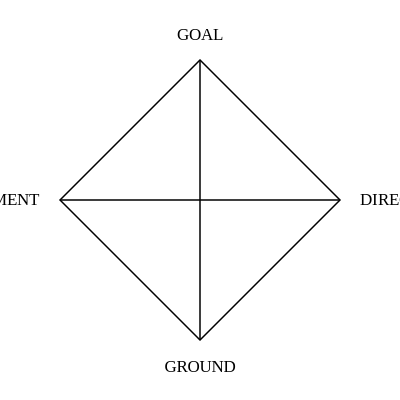
The Four Points of the Diagram
Bennett builds the tetrad from a single distinction: every ordered activity has a whence and whither — where it starts and what it is for — and also a how, when and where — the means by which it actually gets done. The first pair he calls motivational, drawn as the vertical arm of the cross; the second pair he calls operational, drawn as the horizontal arm:
- Ground (bottom, motivational) — "the relatively formless raw material of the action: as soil is ground for the growth of a plant." It is also the initial situation in time, the point from which the activity starts, and "includes the separate urges of all the component elements through which they come together in a concerted activity." Elementary Systematics glosses this as the material source — quantity, fact, the given "stuff" the activity works on.
- Goal (top, motivational) — "the ideal pattern which can unite all the components of the activity into a structured whole… the central theme or motive that sustains the activity." It is not merely an end-point in time but the pattern the activity conforms to even before it starts. Elementary Systematics calls this the spiritual source — quality, value, "the direction where significance… is found."
- Instrument (left, operational) — "the strictly operational term. It comprises the entire inner working of the activity with all the mutual adjustments it calls for" — the 'left hand' as the field of action, having, when human, "the qualities of feeling rather than thought." Elementary Systematics calls this the feminine source: skill or technique — the ability to carry a process through in practice.
- Direction (right, operational) — "the cognitive element whereby the activity is ordered and adjusted to all other activities with which it is connected" — the 'right hand' as leader of the concerted action, the guiding intelligence by which the activity is focused and recognized as a whole. Elementary Systematics calls this the masculine source: knowledge, the theoretical grasp that relates the activity to the larger whole it serves.
The four points are joined by six lines — the tetrad's interplays — since "each term is relevant to the other three." Ground–Goal is the spectrum of motivation itself, running from pure need to pure aspiration; Instrument–Direction is the spectrum of instrumental agencies, from pure self-regulation to pure external guidance. Of the four diagonals, Goal–Direction is doing a job for its own sake against doing it to serve a greater purpose; Goal–Instrument is integrity, that the activity not be divided against itself; Ground–Direction is governance, keeping the activity "on the track"; and Ground–Instrument is skill, the economical use of materials.
Key Points
- Bennett gives the tetrad three interchangeable symbols, each bringing out a different aspect: the square, which shows activity as both the ordering of the ground and the attainment of the goal (Being and Becoming together); the cross, whose four points and six connecting lines are shown above; and the tetrahedron, whose base triangle (Ground, Instrument, Direction) is what is actually going on, crowned by the Goal as apex — "a common element which changes the character of the three other terms."
- Aristotle's four causes are treated in The Dramatic Universe as a classic tetrad: his Formal and Material principles correspond to Bennett's Goal and Ground, and — less obviously — his Final and Efficient causes correspond to Direction and Instrument respectively, "his wonderful insights into the workings of nature" thereby recast in systemic terms.
- In practical work (as taught in Elementary Systematics) the tetrad is the instrument for diagnosing why an activity fails: one of the four sources is missing or usurping the others' place — illustrated there through cooking, gardening, scientific research and the tetrad of Jung's four psychological functions (intuition as spiritual source, sensation as material, thought and feeling as the operational pair).
- The tetrad's limitation is exactly its strength: "the limitation of the tetrad consists in its lack of central emphasis" — it orders an activity but cannot say for whom or what the activity is significant, since it has no centre. That question belongs to the pentad.
In the Sources
- The Dramatic Universe III is explicit: "the tetrad is the system that governs all ordering activity," and its four sources are "Ground, Goal, Direction and Instruments" — the scheme in which man appears "as maker of things and transformer of energies."
- The same volume sets down the full terminology: "Four-term System: TETRAD. Systemic Attribute: ACTIVITY. Term Designation: SOURCE… MOTIVATIONAL: Ground, Goal. OPERATIONAL: Direction, Instrument… 1st Order Connectivities: INTERPLAYS. There are six interplays."
- It also notes both the power and the limit of the system: two superimposed tetrads give the seven gradations of the Pythagorean tetrachords, but "although the tetrad is the symbol of Being, it does not allow for the existence of separate entities… this is directly due to its lack of a centre."
- The Dramatic Universe II uses the tetrad as the instrument for the classification of the energies: within each tetrad two opposing characteristics blend in different degrees, generating the scale of energy qualities.
- Elementary Systematics closes its tetrad chapter with the working rule: "For a complete understanding of an activity, both the simplicity of the tetrad and the complexity of the particular situation must be held in mind together" — illustrated by the tetrad of scientific activity (vision, knowledge, technique, contact), with Madame Curie as the exemplar of technique and Einstein of vision and knowledge without contact.
Related
In the Books
Where “Tetrad” appears across the collected texts.
DU I — 4 sections
DU II — 8 sections
DU III — 27 sections
- Part Fourteen: Systems Chapter 37. the Structure of the World 24×
- Chapter 29. 16×
- The Transformation of Value Experience 14×
- The Structure of the World 13×
- Glossary of Terms 12×
- The Element of Will 11×
- The Aristotelian Tetrad 10×
- The Mind as Ordering Activity 10×
- Acts Generation 6×
- The Ideal Human Society 6×
- Values 5×
- The Structure of Human Activity 4×
- Existential Being— the Personality 3×
- Order 2 Expansion 3 Identity 4 Freedom 5 Concentration 6 Interaction 3×
- Lychanos 2 Parhypate 1 Hypate 3×
- Sub-Structures 3×
- Anthropology 2×
- The Higher and Lower Natures 2×
- Existential Will 2×
- The Essential Nature 2×
- Human Societies 2×
- Co-Operation in the Psychokinetic Group 2×
- Accelerated Transformation 1×
- Motivational: Ground Goal Operational: Direction Instrument 1×
- Discrimination 1×
- Individuality 1×
- The Stages of Life 1×
DU IV — 15 sections
- Germinal Striving the Soil 6×
- The Progress of the Epoch 6×
- Foreordainment 3×
- The History of Soul 3×
- I6.43-5-7- Supernatural History 3×
- The Maturing of Mind 2×
- The Great Spirit 2×
- Part Sixteen: Prolegomenon to History Chapter 42. the War with Time 1×
- Chapter 44. the History of Life on the Earth 1×
- Introduction 1×
- Directional Heptad 1×
- Providential History 1×
- D.u. Iv—6 1×
- The Coming of Man 1×
- The Next Act of Mind 1×
Deeper Man — 1 section
A Spiritual Psychology — 3 sections
Creation — 7 sections
- The Three Tetrads 14×
- Apupa 13×
- Rupa 3×
- Foreword 2×
- Names from Bennett 2×
- Front Matter 1×
- Tetrad of Deity 1×
Creative Thinking — 2 sections
Elementary Systematics — 16 sections
- Examples of Tetrads 24×
- The Tetrad 10×
- Front Matter 9×
- Scientific Activity as a Tetrad 8×
- Connections Among the Four Sources 8×
- The Pentad 6×
- Chapter 5×
- Naming the Four Sources 5×
- A Final Comment 2×
- System Attribute Term Character 2×
- Introduction 1×
- Systems and Structures in Systematics 1×
- Identifying Systems 1×
- Integrating Multiple Perspectives 1×
- Jinal Comments on the Triad 1×
- The Connection Between Source and End) 1×